The Marketers Playbook: Path to Personalized Digital Experiences
7 juillet 2026 • 1 Minute Read • Stephanie Saia, Responsable de pratique, personnalisation et optimisation


Traditional personalization was built around the goals of improving engagement, increasing conversion rates, and strengthening customer retention. But traditional personalization is also built on static rules, which is no longer enough.
Today's consumers expect brands to understand and respond to their needs in real time. AI is making that level of relevance more attainable, but many marketing teams still rely on static audience segments and predefined rules.
As they begin exploring AI-powered personalization, the opportunity—and the challenge—is to move beyond broad assumptions and create experiences that adapt to each customer’s context.
For those teams, the shift doesn't mean replacing everything they already have. It means understanding where and how AI can make personalization more responsive, more useful, and easier to scale.
Consider a simple travel/tourism example. A traditional approach might use a rule like, “If visitor = travel/tourism, show travel/tourism banner.” An AI-enabled approach can evaluate more signals and adapt the experience as the visitor's behavior and intent become clearer.
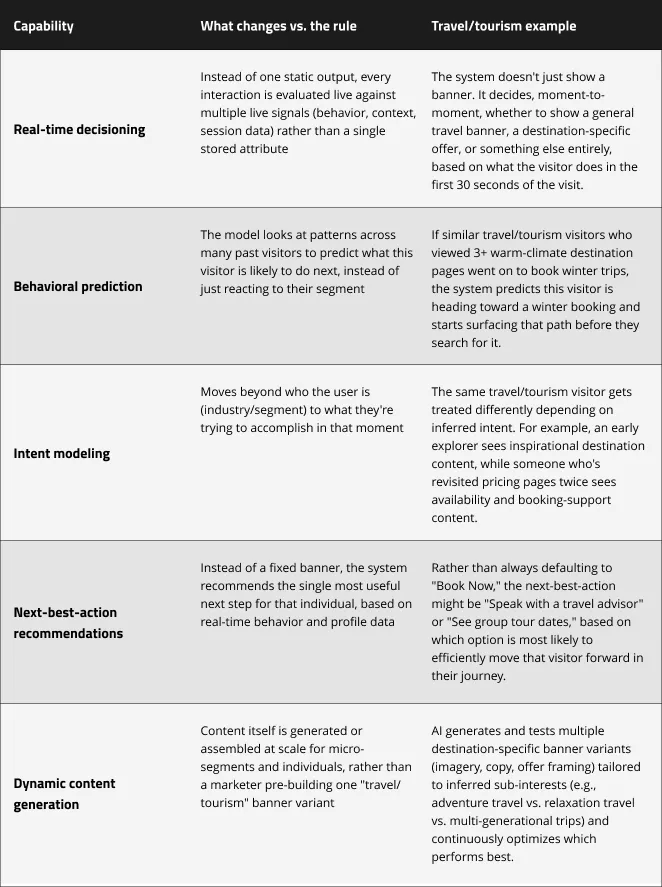
These capabilities represent where personalization is headed. But they don't all need to be in place today. The more important question is how they change what personalization can accomplish. Here are four ways that shift matters:
For years, personalization was often measured by surface-level engagement: more clicks, more pages per visit, lower bounce rate, longer time on site. Those metrics still matter, but they can be misleading on their own. A visitor can spend more time on a site because the experience is useful. However, they can also spend more time because they cannot find what they need.
Personalization that adapts in real-time makes engagement more meaningful because it connects behavior to intent.
For example, a visitor who reads three articles on the same topic is sending a different signal than someone who scans one overview page and leaves. And a returning visitor who goes straight to pricing or a product- or service-specific page is showing a different level of readiness than a first-time visitor.
For marketers, the goal is to identify the moment when the experience should shift from treating someone like an unknown visitor to responding to their behavior in real-time.
CDM Smith is a good example of how this works in practice. CDM Smith is a global engineering and construction firm specializing in water, environmental, and infrastructure solutions. One of the company's solutions is detecting, treating, and remediating PFAS, persistent "forever chemicals," which is a high-value personalization opportunity.
Verndale’s recommendations focused on helping visitors with clear PFAS-related intent find more relevant information and a stronger path to expertise, including:
The same user can require different experiences in different moments:
The audience label helps, but it shouldn't be the only input.
Real-time decisioning depends on several signals working together: behavioral data, referral source, content engagement, known profile data, session activity, device and location context, and prior interactions when available.
The experience then needs a way to decide which message, CTA, offer, search result, product, content recommendation, or support path is most useful.
This is where an organization's marketing and technology teams have to work together.
When targeting becomes decisioning, personalization is no longer limited to “show this audience this version.” It becomes a system for choosing the next best experience for a specific user using the information available in real time.
Personalization should improve the experience for the user while also helping the organization gather key learnings in the process. That only happens when personalization is measured as a cohesive system. If a personalized hero performs better, the team should know why. Otherwise, they risk scaling an experience that worked for reasons they don't fully understand.
AI can also reduce some of the operational work required to scale while giving your team more capacity for testing. Tools such as Optimizely Opal can help teams with repeatable production tasks, including drafting content variations, applying metadata or tags, summarizing source material, and checking content against established requirements.
The key is to apply AI where the work is repetitive and the rules are clear. The goal is to reduce the cost and effort required to create, manage, and improve experiences that are worth scaling.
Quinnipiac University is a good example of why that foundation matters. In our work together, Verndale helped build a scalable digital platform with reusable content structures and a site-wide tagging system. That gave Quinnipiac a more consistent way to organize and manage content across a large digital presence that's grown to 17 sites and 8,800+ pages.
When we later worked with Quinnipiac to implement a personalization program using Optimizely Data Platform (ODP), that structure gave the team a head start. Existing taxonomy and tagging made it easier to connect content to audience interests and behaviors, supporting personalized experiences such as surfacing relevant programs or events for prospective students without creating a separate experience from scratch for every audience.
The path from static rules to adaptive personalization requires agreement across technology, marketing, content, data, analytics, and platform teams.
A useful starting point is to define the first few high-value moments where personalization could change behavior. Those moments should be specific enough to test. For example:
Once those moments are defined, the team can determine which data signals are available, which content should be shown, which system will make the decision, and which metric will determine whether the experience was successful.
Verndale takes a comprehensive approach to personalization, combining expertise in personalization strategy, content strategy, analytics, data, technology, and search. This model helps teams define the right audiences and signals, create reusable and discoverable content, connect data and platforms, and measure what's worth scaling.
That's the different between personalization as a campaign tactic and personalization as a business capability. Campaigns can produce wins, but a capability helps you keep learning and improving.
Many organizations already have pieces of the personalization puzzle: a CMS or DXP, analytics, marketing automation, audience segments, content, and a few ideas for personalization. The challenge is connecting them.
If you're looking to modernize your approach, Verndale’s Path to Personalized Digital Experiences gives you a self-guided way to see where you are today and what to tackle next. It covers four areas: strategy and governance; data, taxonomy, and identity; experience orchestration; and experimentation and optimization. You'll also get a personalization maturity diagnostic and guidance on when to consider more advanced, AI-driven use cases.
Prefer to talk it through? Verndale's complimentary two-hour Personalization Readiness Assessment takes a closer look at your audience insights, data and technology, journey optimization, and experimentation capabilities. You'll leave with prioritized opportunities tied to your business goals.
Either way, the goal is the same: start with one opportunity, test it, measure the results, and use what you learn to decide what comes next.