Agentic AI in Marketing for Decision-Driven Growth
27 janvier 2026 • 6 Minute Read • Tod Szewczyk, Directeur principal, services marketing

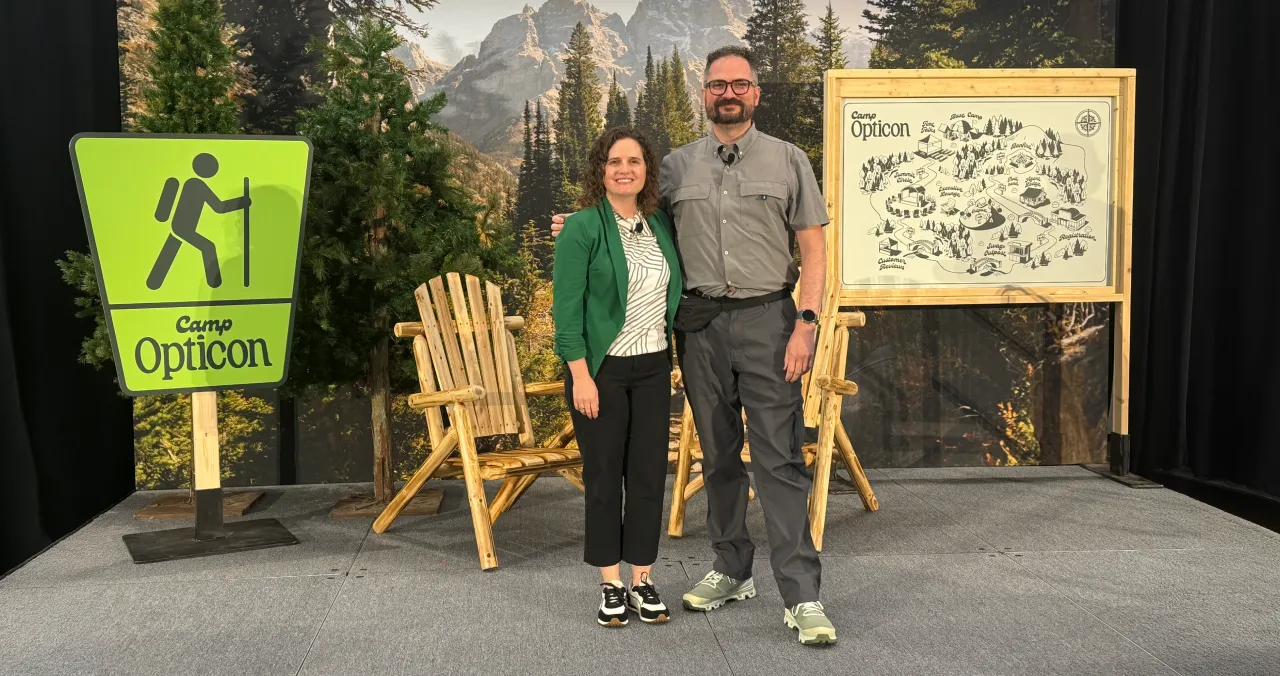
Lisa Scrofani (left), Director of Product Strategy at Quinnipiac University, and Doug Yoder (right), Technical Director at Verndale and an Optimizely MVP at Optimizely's marketing conference, Opticon 2026. The two shared how the Quinnipiac and Verndale teams put AI agents to work on specific, real-world marketing tasks—from surfacing hidden content to optimizing pages for both visitors and AI search. The story illustrates a broader shift in how marketing teams can get more value from the content they already create.
If you're in content marketing or digital marketing, or the person responsible for keeping your company's website and digital channels populated and up to date, you already know the value of repurposing content.
A webinar becomes a blog post. That blog post becomes a LinkedIn article or shareable social posts. A customer story turns into an email campaign. Effective marketing teams always look for ways to extend the life of their best ideas.
But today’s digital landscape demands more than repurposing. Each piece of content now serves multiple audiences across many channels.
In addition to your site’s visitors, digital content is also consumed by AI search engines, recommendation systems, internal teams, and even future digital experiences we can’t yet imagine.
It's tempting to look at AI-generated content and think that's your answer to doing more. Instead, this story shows why digital experience demands content activation—unlocking more value from existing content.
That's exactly the challenge Quinnipiac University set out to solve for QU.edu. Lisa Scrofani, who oversees the university’s implementation of Optimizely suite of tools and other digital products, knew she didn't just want to save her team time. She saw an opportunity even greater than that.
Every major technology shift changes how marketing work gets done.
The web changed how we published stories, social media changed how we distributed content, and mobile changed how customers experienced it. AI is no different.
"AI gives our teams the opportunity to reapproach old problems—and entirely new ones—in ways that simply weren't possible before," shares Lisa. "This is true in any industry or business model. For some, it means simplifying compliance. For others, it means improving checkout or customer support. For us, it was operationalizing content activation across the website and for AI search."
The Quinnipiac marketing team wasn't short on great stories. They have faculty featured in national media, compelling student and alumni testimonials, and a steady stream of news content that reflects everything happening across the university.
"We realized we didn't have a content-creation problem. Some of our most valuable stories were only being experienced once and could have more mileage," says Lisa.
Quinnipiac saw an opportunity to use agents to assist with optimizing content and page quality—and leveraging that same content in multiple ways across university-owned channels.
One of the biggest misconceptions about AI is that it needs to be creative to be valuable. In reality, some of the best opportunities are surprisingly operational. This was the foundation for building the digital marketing team's first agents.
"In our experience, some of the most impactful applications are operational. Think about the work your marketing team performs every week across content QA, CMS updates, or metadata. Those are all structured decisions that you make repeatedly," shares Doug.
"We weren't looking for AI to be creative," adds Doug. “We were looking for AI to consistently handle structured work so our team could focus on the decisions that matter."
To start, Quinnipiac and Verndale identified use cases that are:
Through these criteria and a review of their content backlog, the team found several important tasks that often fell behind higher-priority work.
They focused on four use cases representing existing content that had the potential to be easier to discover, reuse, and scale:
Designing the operating model came next. The real challenge was to not burn credits while testing and iterating, which required effectively setting up clear instructions and guidelines for getting the agents to work.
Leveraging Optimizely’s Agent Platform, Mark (formely known as Opal), and the university's CMS, the workflow agent ran like this:
This workflow enabled AI to become another member of the team—handling structured, repeatable work while humans continued to own creativity, strategy, writing, messaging, governance, and audience understanding.
The primary outcome for Quinnipiac's agents wasn't just faster publishing; it was a completely different content lifecycle.
The existing content could now become:
"Content must be unique to us and move the needle to ensure we’re visible in an AI-search-first world,” shares Lisa. “Marketers need AI that's consistent, easy to use and in systems they're already in and that's what we're accomplishing with our AI agents."
The process is the biggest lesson. Here are some takeaways for organizations exploring Mark for an AI initiative.
Don't try to automate everything. Look for work that's structured, repetitive, and can be valuable to the business.
The quality of the outcome depends on a clear process. Document the work first, then show AI how to do it.
AI is exceptionally good at structured tasks. Humans remain essential for judgment, strategy, governance, and brand stewardship.
Taking the leap to agentic AI requires alignment. Engage people from across the team so everyone is ready to consider and implement the AI enablement. For Quinnipiac, that meant bringing in Verndale to illustrate what the implementation will look like.
Your first version won't be perfect, and you'll spend time formatting and testing while optimizing for speed and efficiency without incurring unnecessary credits. Treat an agent implementation like any other product: test, learn, refine, and repeat. Plus, plan for who will own the processes and upkeep of agents and AI skills.
One question comes up with teams that Doug and our experts work with: Could we do something like this?
Doug helps clients do this every day. "The challenge is sifting through dozens of use cases to identify the right one," he shares. "Instead of wondering what to build with your agent, ask what work you've been wanting to do for years that never quite made it to the top of the backlog."
That's a simple shift that uncovered Quinnipiac's four valuable opportunities well-suited for AI.
Quinnipiac’s story shows how amplifying your expertise with existing content can transform marketing operations. Every organization has its own goals, but the lesson is to focus on work that's structured, repeatable, and valuable.
Start by looking at problems or tasks that rarely get enough attention. If an AI agent joined your team today, which jobs would you trust it to handle?
To help you get started, try our free Optimizely AI Agent Platform Readiness Assessment. This engagement will show you which workflows can be automated safely, what it will cost or save, and what results to expect. It comes with an executive output you can use to give clear, actionable answers to your leadership.