B2B Online 2026: Why Speed, Data, and Adoption Matter More Than Ever
May 13, 2026 • 4 Minute Read • Commerce Strategy Team, Verndale
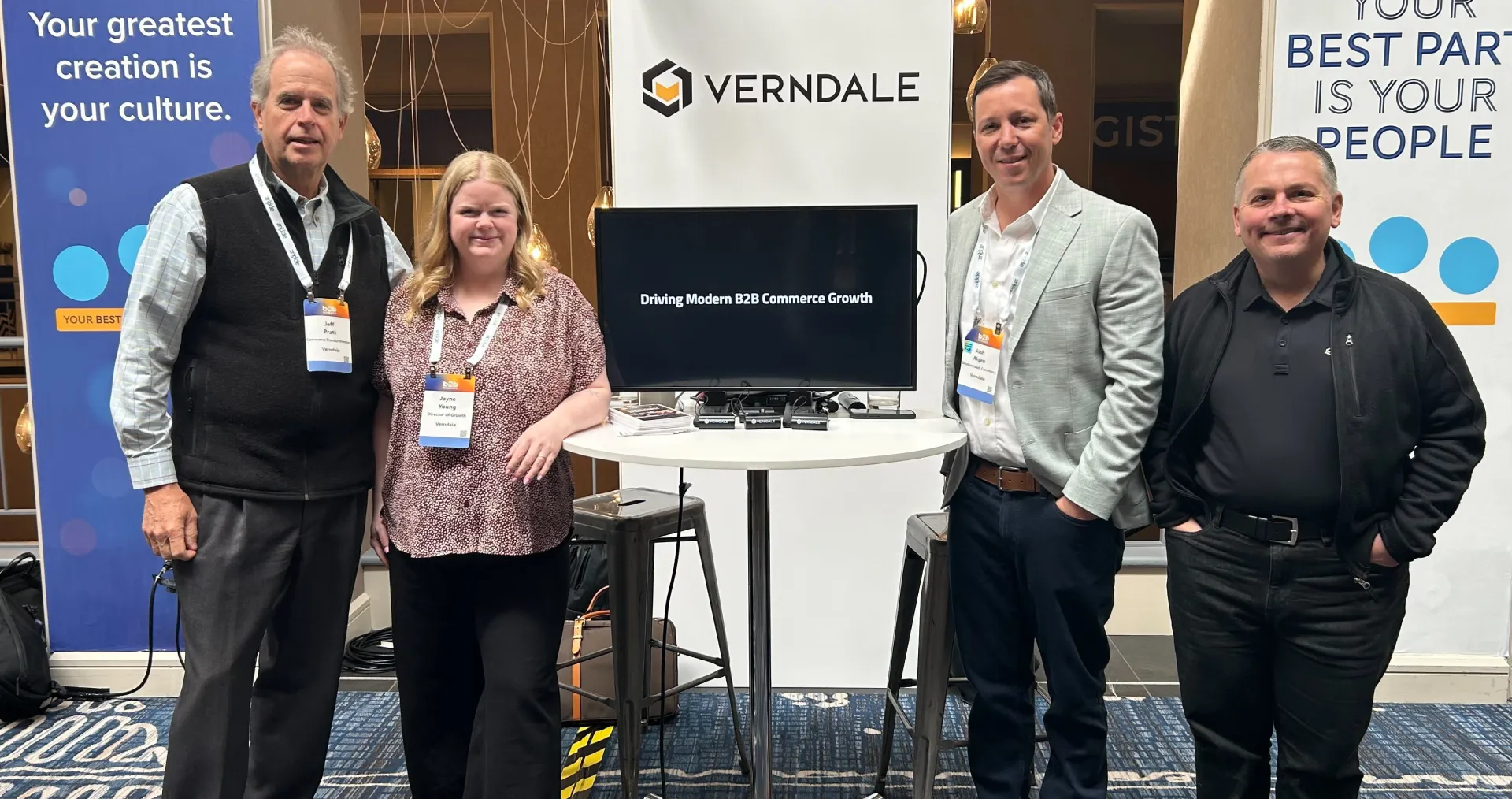

The clearest signal across Commerce Live and B2B Online wasn't about composable commerce or AI features. It was about operability, and where B2B teams are struggling to execute.
Verndale was recognized at the BigCommerce 2026 Commerce Awards as an Innovator in the B2B space. The observations below are drawn from our time across both events.
For the last few years, B2B commerce conversations have centered on architecture: headless or monolith and composable or suite. Pick the right stack, and everything else would follow.
That conversation is winding down. The teams we're working with this year have already made those calls. What's slowing them down isn't the platform anymore, but their ability to operate it.
That's the shift BigCommerce came to address at Commerce Live, and the one the recent B2B Online trade show surfaced from the buyer side.
The product announcements, the AI roadmap, and the displayed buyer behavior data all point in the same direction. The constraint has moved from architecture to operability, and BigCommerce is investing where the friction lives.
BigCommerce got the framing right at Commerce Live by presenting its AI stack as a system. MCP lets AI tools build directly on the platform.
Together, these layers shrink the distance between discovery and transaction. They also expose the underlying foundation in ways it wasn't exposed before.
Fragmented catalogs, inconsistent pricing, and slow systems were once internal problems. Once agents are in the loop, customers can see inconsistencies in catalogs and pricing.
That tracks with what came up at B2B Online—26% of B2B search now happens through LLMs (B2B Online Panel: Future Proof Your B2B Playbook), and buyers are interacting on channels suppliers don't control.
BigCommerce's stack is built for that reality. The agent layer makes the existing data quality requirements visible to the market.
That changes the stakes of how data is presented to prospects at the moment of decision, and BigCommerce is one of the few platforms with a coherent answer to it.
The biggest signal at Commerce Live was how BigCommerce is positioning Feedonomics.
The storefront isn't the center of the buying journey anymore, and BigCommerce knows it.
A PacSun example made the strategy concrete: Feedonomics handles catalog distribution across marketplaces, retail media, and AI surfaces, while BigCommerce powers checkout. This means the storefront becomes one channel among many.
For B2B teams, that raises the bar on product data.
Generic descriptions written for SEO get ignored by buyers and AI systems alike. Visibility now depends on how clearly product data explains what makes a business different, and how cleanly that data flows across surfaces.
BigCommerce's investment in Feedonomics reads more strategically in this light. It positions the platform as infrastructure for discoverability, not just a storefront engine. Feed strategy is becoming table stakes for participation in the buying journey, and BigCommerce is deliberately building toward that future.
Architecture used to be the bottleneck. It isn't anymore, and BigCommerce's product investments this year suggest they see it.
Across the engagements we're running, the friction isn't with technology choices. Those have been made. The friction is with:
In that environment, more architectural flexibility doesn't translate into more speed. Often, it just adds more to manage.
This is where BigCommerce's investments in Makeswift and Catalyst look well-timed. Both aim to enable platform teams to operate without long development cycles or cross-team dependencies. That's a direct response to where B2B teams get stuck.
B2B Online echoed the same theme. Speed isn't a tooling problem anymore. It's a question of how quickly teams can align, execute, and improve.
Here's the uncomfortable part for the broader market:
Many teams that replatformed in the last two years are sitting on more flexibility than they can use. The next phase is the operating model that turns flexibility into pace. The commerce platform providers that read this correctly will be the ones whose customers are actually shipping, and BigCommerce is one of them.
BigCommerce's Purchase Order Agent is a useful preview of where AI value lands first in B2B, and a smart choice for the platform's first agentic product.
Today, POs in most B2B environments are still received, reviewed, and processed manually. The work is repetitive, time-consuming, and critical to keeping the rest of the order flow moving. AI removes manual steps from an existing workflow.
That pattern matters because of customer expectations.
Most B2B buyers aren't asking for new ways to interact with suppliers. They're trying to complete known tasks more efficiently.
The fastest ROI from AI in B2B comes from automating tasks, not from inventing new ones. We see this consistently in client conversations. The use cases that get funded are the ones that compress time on workflows everyone already understands.
BigCommerce, starting with the PO Agent, signals that the platform is building agentic capability where customers will feel it first, not where the demo looks best.
What BigCommerce is building tracks where the real work sits: data, integration, and execution.
The platform is investing in the layer where B2B teams increasingly feel friction.
That translates to an operating model question. It's also the question most B2B teams haven't fully started on, even when their ecommerce platform is ready for it.
The teams moving fastest right now are doing three things:
This is the diagnostic work that turns a flexible platform, including a well-architected BigCommerce environment, into a fast operation.
It's also the work that gets skipped most often, because it's harder than running another vendor evaluation.
For a detailed breakdown of what shipped at Commerce Live in Chicago and what's on the roadmap, see: Along the Frontlines from Commerce Live Chicago: What's Live, What's Coming, and What It Means for B2B.
This shift didn't show up in our 2026 engagement model by accident. We saw the same signals BigCommerce is responding to, and we've rebuilt our engagement model around them.
Whereas engagements used to start with ecommerce platform conversations, they're now starting with diagnostic ones, identifying where data is creating friction, where integration gaps are blocking decisions, and where workflows are slowing teams down.
That diagnostic work is what makes the platform investment pay off.
Our delivery model has shifted with it as well. AI runs through every phase of our engagements, from discovery through delivery, increasingly orienting our architecture work toward AI agent-readiness. This means catalogs structured for AI discovery, integrations built to support automated workflows, and operating models that let platform teams actually use the flexibility BigCommerce is putting in their hands.
The outcomes track with the shift. Clients are achieving operational AI value faster, enabling them to see ROI. Marketing, merchandising, and IT are running tighter loops. And BigCommerce environments are reaching a state where customers can make changes without queuing everything behind an engineering cycle.
BigCommerce is building the platform that addresses this shift. And we've rebuilt our practice around helping clients operate it.
If that's the conversation you're trying to have inside your business right now, let's connect.