4 Ways Web Personalization Is Evolving in the AI Era
Oct 26, 2026 • 10 Minute Read • Stephanie Saia, Personalization & Optimization Practice Lead

What happens when visitors can’t find what they need on your website? We solved the problem.
Imagine a potential B2B buyer arriving on your website looking for information about a Kafka connector. They click through a few pages and complete a search using relevant keywords but get no results. Unable to find what they’re looking for, they leave emptyhanded.
Meanwhile, your customer data platform (CDP) has recorded their browsing behavior and unsuccessful search. But by the time your marketing team reviews those insights, the visitor is gone... as is the opportunity to help them.
This begs the question: What if the CDP could recognize those signals and your website could respond before the user left?
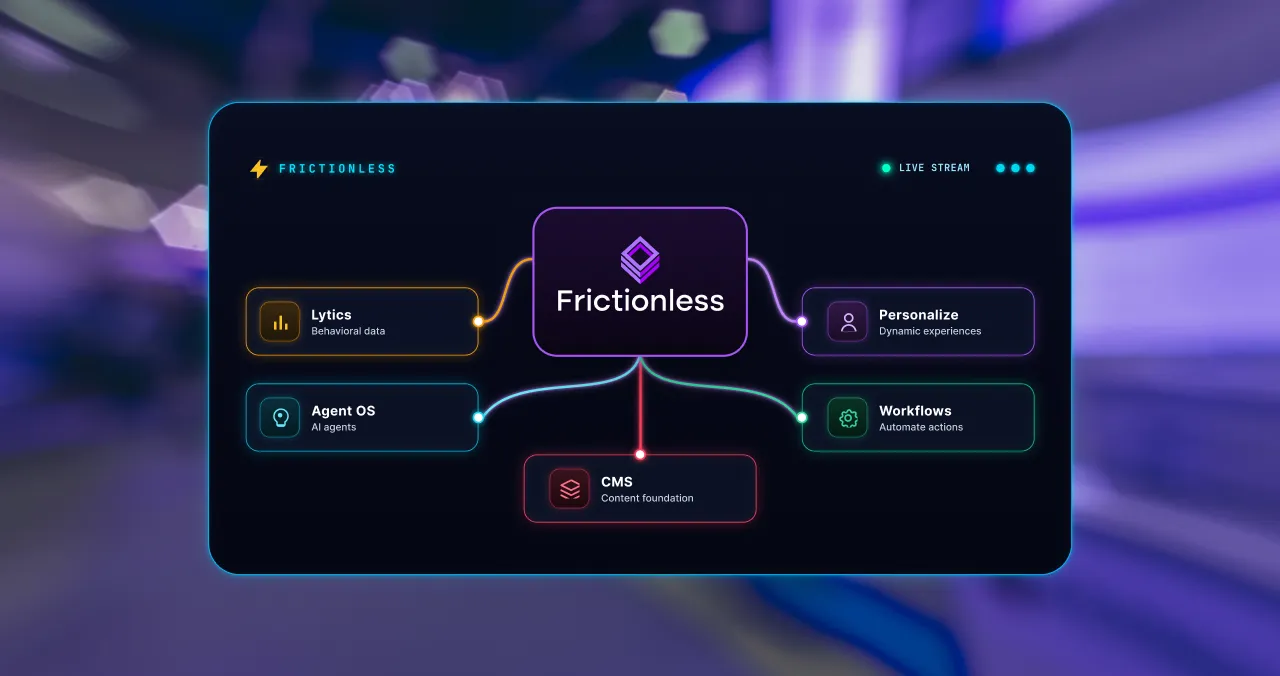
That's the idea behind Frictionless, a real-time behavioral decisioning solution developed by Verndale for Contentstack. By connecting live behavioral data, customer context and Contentstack's experience capabilities, Frictionless identifies where buyers are struggling and adapts the experience to help them move forward.
B2B buying journeys are rarely linear. Prospects move between product information, technical documentation, comparisons, and pricing as they evaluate solutions. Their questions and needs evolve along the way.
Yet many websites still rely on predetermined paths and generic calls to action, regardless of what an individual visitor is trying to accomplish.
Repeated navigation, unsuccessful searches, and abandoned forms can all signal that an experience isn't meeting a buyer's needs. Traditional analytics can reveal these patterns, but often only after the visitor has left.
Frictionless closes this gap by bringing together several technologies to turn visitor signals into relevant, actionable responses:
Together, these capabilities enable Frictionless to recognize when a visitor is struggling, understand their context, and determine how the experience should respond.
That might mean changing the homepage message, presenting a more relevant call to action, shortening a form or generating content to address an unanswered question—all while the visitor is still engaged.
Let’s go back to our example about a customer searching a B2B site about Kafka Connector. A standard journey would likely stop when a site search returned no results. But Frictionless can take that gap and turn it into a more relevant experience for the user, not in the future, but in that very moment. Here’s how it works:
As the visitor navigates the site, Lytics captures behavioral signals in real time. At the same time, Frictionless is analyzing more than nine behavioral attributes from Lytics to identify specific barriers, such as navigation confusion, low relevance, trust deficits and insufficient proof. Each contributing is signal weighted and traceable to its source, making the diagnosis explainable.
In this case, when the search returned no results, Frictionless identified the issue as navigation confusion.
Next, the visitor begins filling out a form. The information flows into HubSpot, where company details, including industry and employee count, are enriched and passed back into Lytics. Based on that enrichment, the visitor is categorized as an enterprise user.
Frictionless now has a more complete picture: the visitor's browsing behavior, unsuccessful searches, behavioral history and firmographic context from HubSpot. Together, these signals help the agent understand the visitor's needs and determine what kind of assistance may be most relevant.
Using these signals, the agent evaluates the visitor's friction profile and selects an appropriate experience variant.
The decision is recorded in Contentstack, including the behavioral signals, friction scores, inferred friction profile, and selected response. This creates an audit trail that makes the decision explainable and supports governance.
Importantly, detecting friction doesn't automatically change the experience. The agent first evaluates the available evidence and determines the next-best action.
The website now responds to the visitor's needs. The homepage hero changes to “Tell us what you're solving and we'll skip the tour.” The CTA and supporting content are updated, and the form becomes shorter. A component on the pricing page also adapts to reflect the visitor's enterprise profile.
But Frictionless goes further than adapting existing content.
It recognizes the unsuccessful Kafka connector search as a content gap and can generate new content to address it, alongside additional hero, CTA, supporting content and form variants tailored to the visitor's friction profile. These variants use the Contentstack brand kit to maintain brand consistency.
When the visitor searches for Kafka connector information again, relevant results are available.
The value of Frictionless lies in what it enables marketing teams to do with the technology and data they already have. With Frictionless, teams can:
As digital experiences become more intelligent, personalization is evolving beyond predefined audience journeys. The opportunity is to respond to what visitors are doing in real time, using behavioral signals and customer context to anticipate their needs and remove obstacles.
For Contentstack customers, Frictionless shows how existing investments in content, data and personalization can work together to make this possible. By detecting friction, selecting the next-best action, and adapting the experience while buyers are still engaged, organizations can create more relevant journeys and recover valuable conversion opportunities.
Ultimately, the value lies in acting on buyer intent while it's still high—turning moments of friction into opportunities to move the customer journey forward.